
A revenue management system helps your hotel sell the right room, to the right guest, at the right price. 🏨 Many Indian hoteliers still set rates by gut feeling. Some copy a nearby competitor. Others cut prices the moment occupancy dips. 😟 That habit quietly drains profit every single week. 💸
Demand now shifts within days. Festivals, weddings, flight fares and even weather change booking patterns fast. Manual rate sheets cannot keep up.
This guide explains how the technology works, which features matter, and how to start.
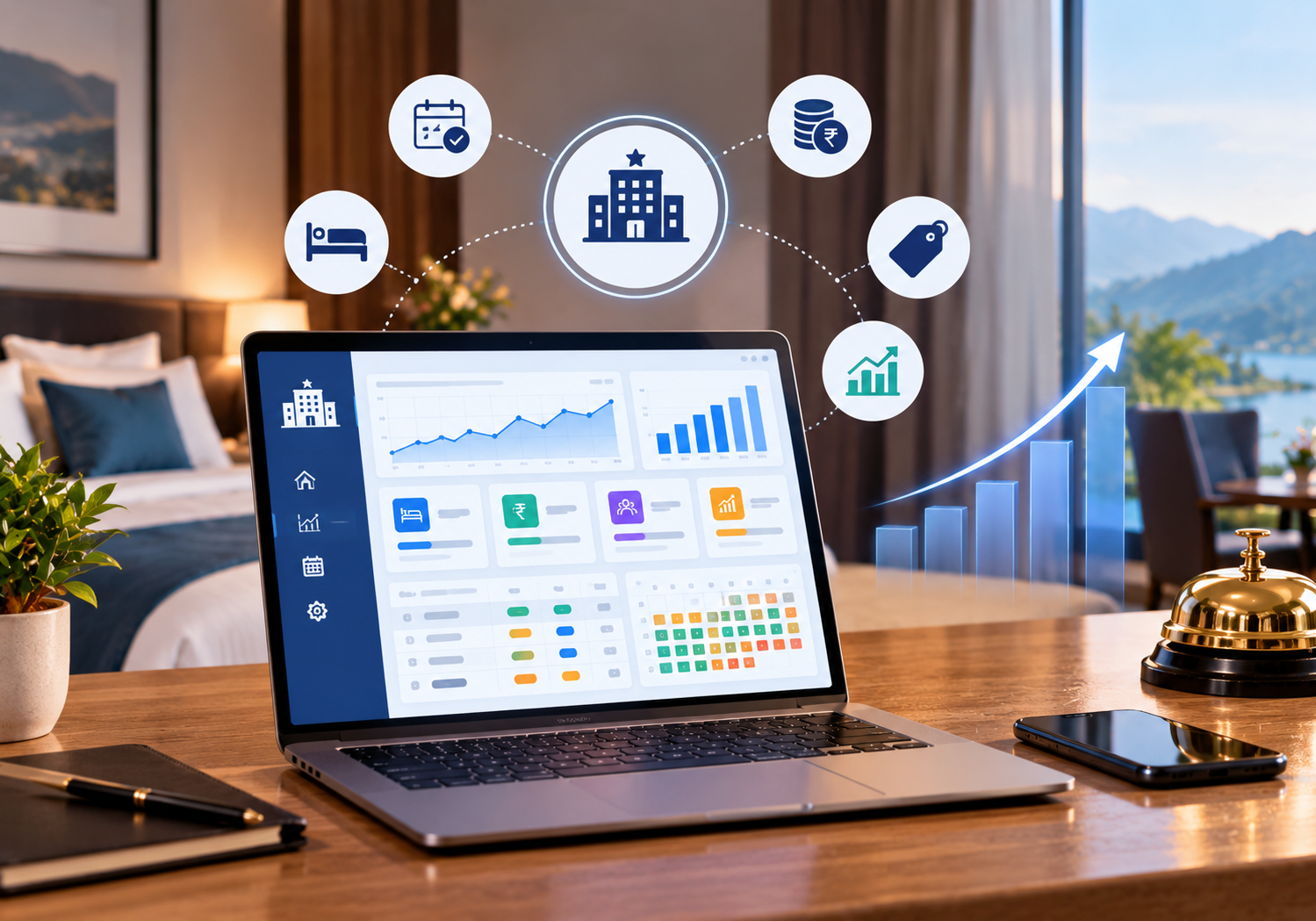
📊 What Is a Revenue Management System?
A revenue management system is software that studies demand and recommends the best room rates. It reviews past bookings, current booking pace, competitor prices and local events. Then it suggests a price for every room type and every date.
Think of it as a smart pricing assistant. It works all day and never gets tired. 🤖
The goal is simple. You earn more from the same rooms. Instead of chasing occupancy alone, you also track RevPAR and ADR.
Here are three quick definitions:
- ADR: average daily rate earned per sold room.
- RevPAR: revenue per available room, combining rate and occupancy.
- Pickup: how fast rooms are booking for a future date.
Want the basic theory first? Read our hotel revenue management complete guide. 📚
🤔 Why Hotels Need Smarter Pricing
Manual pricing has three big problems.
- It is slow. By the time you update rates, the demand spike has passed.
- It is biased. Fear of empty rooms pushes owners to discount too early.
- It is disconnected. Rates on your website, OTAs and front desk often differ.
Automation fixes all three. It reacts quickly, follows data, and keeps prices consistent. ⚡
Here is a simple illustration. Suppose a 30-room hotel sells rooms at ₹4,000 on a festival weekend. Demand data may show guests would happily pay ₹4,600. That extra ₹600 on 25 rooms adds ₹15,000 per night. Over three nights, the gain reaches ₹45,000. 🎉
This is an example, not a guarantee. Real results depend on your market, season and property type.
Indian travellers also book later and compare more. Online travel agencies charge commission on every stay. Smarter pricing on your own channels protects your margin. See how fees add up in our OTA hidden fees guide. 🔍
⚙️ Key Features of a Revenue Management System
Not every tool offers the same depth. Look for these core features.
1. Demand forecasting 📈
The system predicts occupancy for the next 30, 60 and 90 days. It learns from your own booking history. Forecasts improve as more data flows in.
2. Dynamic pricing 💰
Rates change as demand rises or falls. You set a floor price and a ceiling price. The system always stays inside those limits.
3. Competitor rate tracking 🕵️
You see what nearby hotels charge today, you can then price with confidence and you also avoid blind undercutting.
4. Rate restrictions 🔒
Minimum-stay rules and closed-to-arrival settings protect peak dates. A good tool applies them without manual effort.
5. Reports and insights 📑
Clear dashboards show ADR, RevPAR and pickup. The SaasAro reports module turns raw numbers into simple views.
6. Instant channel updates 🔄
Price changes must reach every channel within seconds. Otherwise guests see different rates for the same room. Our channel manager pushes updated rates to 200+ OTAs.
🔍 How Dynamic Pricing Works, Step by Step
The process looks complex, but the logic is simple.
Step 1: Data collection. The tool gathers your bookings, cancellations and room inventory.
Step 2: Demand analysis. It compares today’s pace with the same period last year.
Step 3: Market check. It reads competitor rates and upcoming local events.
Step 4: Price suggestion. It recommends a rate for each room type and date.
Step 5: Approval or automation. You approve the rate, or let the system publish it.
You stay in control throughout. Most hoteliers start with approval mode. They switch to automation once trust builds. 🤝
🧩 How It Connects With Your Other Hotel Software
Pricing tools do not work alone. They need clean data from other systems.
- Your property management system supplies room status and reservations.
- Your booking engine captures direct bookings at the live rate.
- Your channel manager distributes prices to every OTA.
When these tools share one database, errors drop sharply. You avoid double bookings and rate mismatches.
Unsure how these tools differ? Read our channel manager vs PMS vs CRS comparison. It clears the confusion quickly. 💡
📌 Metrics Every Hotelier Should Track
Software is only useful if you read the numbers. Track these five metrics weekly:
- 🏨 Occupancy rate: the share of rooms sold.
- 💵 ADR: shows whether your prices are holding.
- 📈 RevPAR: the best single measure of room performance.
- ⏳ Pickup pace: warns you early when demand is weak.
- 🌐 Direct booking share: shows how much commission you save.
Do not judge success on occupancy alone. A full hotel at low rates can earn less than a half-full hotel at strong rates.
🏆 Benefits You Can Expect
Hotels that adopt pricing automation usually see steady gains. Results vary by market and property type.
- 📈 Higher RevPAR through better rate decisions
- ⏱️ Time saved because staff stop updating rates by hand
- 🎯 Fewer discounts during high-demand dates
- 🛡️ Less OTA dependence by promoting direct rates
- 😊 Better planning for staffing and inventory
Small hotels gain too. A 15-room homestay faces the same demand swings as a large resort. In fact, small owners lose more when they misprice a single weekend.
🏡 Who Should Use It?
Different properties use the tool in different ways.
- City hotels: react to business travel and weekday patterns.
- Resorts: manage peak seasons, long stays and package rates.
- Heritage and boutique stays: protect premium positioning.
- Homestays and guest houses: avoid underpricing busy weekends.
Our hotel management software for hotel chains guide shows how multi-property owners manage pricing together. 🏢
🛠️ How to Choose the Right Revenue Management System
Follow this checklist before you buy.
Step 1: List your goals. Do you want higher rates, better occupancy, or less manual work?
Step 2: Check integrations. The tool must connect to your PMS, booking engine and channel manager.
Step 3: Test ease of use. Your front desk team should understand it within one day.
Step 4: Ask about support. Local support in India matters on busy festival weekends.
Step 5: Compare costs. Look at setup fees, monthly fees and hidden charges. Our hotel management software cost guide explains common pricing models. 💰
Step 6: Request a demo. Seeing your own data inside the tool beats any brochure.
Want to compare vendors? Our hotel revenue management companies review helps you shortlist faster. 📋
🚀 Getting Started: A 30-Day Plan
Week 1: Clean your data. Fix room types, rate plans and past booking records.
Week 2: Set your limits. Decide floor rates, ceiling rates and minimum stays.
Week 3: Go live on a few dates. Test suggestions on low-risk weekdays first.
Week 4: Review and expand. Compare results, then apply it to weekends and festivals.
Review progress every week. Adjust your limits as you learn. 📆
⚠️ Common Mistakes to Avoid
- Setting floor prices too low, which wastes the tool’s power
- Ignoring local events such as Dev Deepawali or wedding seasons
- Overriding every suggestion by hand
- Skipping staff training
- Judging results after only one week
Local events matter a great deal. See how demand patterns work in our Varanasi hotel software guide. 🪔
Trust the data, but keep human judgement. You know your guests best. The tool simply gives you sharper evidence.
🪔 Pricing for Indian Seasons and Festivals
India has some of the most varied demand cycles in the world. One property can see three different seasons in a year.
- Peak season: summer in the hills and winter in Goa and Rajasthan.
- Festival spikes: Diwali, Holi, Dev Deepawali, Durga Puja and Kumbh periods.
- Wedding season: group blocks and long weekends rise sharply.
- Monsoon dip: leisure demand softens, so value packages work better.
Smart pricing helps you raise rates early for spikes. It also helps you protect occupancy in slow months with targeted offers. 🌧️
Last-minute travellers matter as well. Many Indian guests book within a week of arrival. Flexible, data-led pricing captures them before a competitor does.
🔐 Data Accuracy and Trust
Good recommendations need accurate inputs. Wrong room types or old rate plans create poor suggestions.
Review your data monthly. Check cancellations, no-shows and group blocks. Keep one person responsible for data quality.
Be careful with vendor claims too. Ask for a live demo using your own property data. Honest vendors welcome that request. ✅
🏁 Why Choose SaasAro?
SaasAro is a hotel management platform built for Indian hoteliers, with global distribution support. Our revenue management module sits beside the PMS, booking engine and channel manager. Everything runs from one dashboard.
Hoteliers across India use SaasAro to manage rooms, rates and distribution together. Our team supports onboarding, staff training and ongoing optimisation. You never face the setup alone. 🤝
You get one login, one support team and one clear view of performance. Check our pricing page for plan details. 🎯
❓ Frequently Asked Questions
Q1. What is a revenue management system in simple words?
It is software that suggests the best room price for each date. It uses demand data, competitor rates and your booking history.
Q2. Is it only for big hotels?
No. Small hotels, homestays and resorts benefit too. Any property with changing demand can use it.
Q3. How is it different from a channel manager?
A channel manager sends rates and inventory to OTAs. Pricing software decides what those rates should be. They work best together.
Q4. How long before I see results?
Many hotels notice early improvements within a few weeks. Fuller benefits usually build over one to three months.
Q5. Will it replace my revenue manager?
No. It supports your team with data. People still make the final strategic decisions.
Q6. Can it help increase direct bookings?
Yes, indirectly. It keeps your website rates competitive and consistent. Guests then trust booking direct.
Q7. Do I need technical skills to use it?
No. Modern dashboards are simple. Most front office teams learn the basics within a day or two.
Q8. Can I set minimum prices?
Yes. You define floor and ceiling rates for every room type. The system never goes outside them.
🎯 Final Thoughts
A revenue management system is no longer a luxury for large chains. It is a practical tool for every Indian hotel in 2026. Better pricing protects margin, saves time and builds guest trust.
Start small, measure weekly, and grow with confidence. 🌟
📞 Ready to Grow Your Hotel Revenue?
👉 Book Your Free Demo: https://saasaro.com/
📱 Call Us: +91 75000 87037