
Hotel management software for hotel chains changes how a group runs every single property. Guests expect instant confirmations across every location you own. Owners expect one dashboard, not ten separate logins. Hotel chains still running spreadsheets and separate OTA extranets lose bookings every week. India’s hospitality groups are adding new properties every month in 2026. This guide breaks down exactly what growing hotel groups need this year, and how the right platform changes daily operations.
Who This Guide Is For 👥
This guide is written for owners and operations leaders managing two or more properties. It covers boutique hotel groups, heritage collections, and larger regional chains alike. The SaasAro content team draws on hands-on work with 10,000+ properties across India to write it. Every figure cited below comes from SaasAro’s own product data and public vendor pages, not guesswork. This team has published detailed hotel-technology research across dozens of Indian city and state markets throughout 2026.
What “Hotel Chain” Means in This Guide 🏷️
Not every group looks like a global brand with hundreds of hotels. In this guide, a hotel chain means any owner running two or more properties under shared management. That includes a two-property family business in Varanasi just as much as a fifteen-property regional group. The technology challenges scale with property count, but the core problem stays identical: disconnected systems that slow decisions down.
What This Software Actually Does for Hotel Chains 🤔
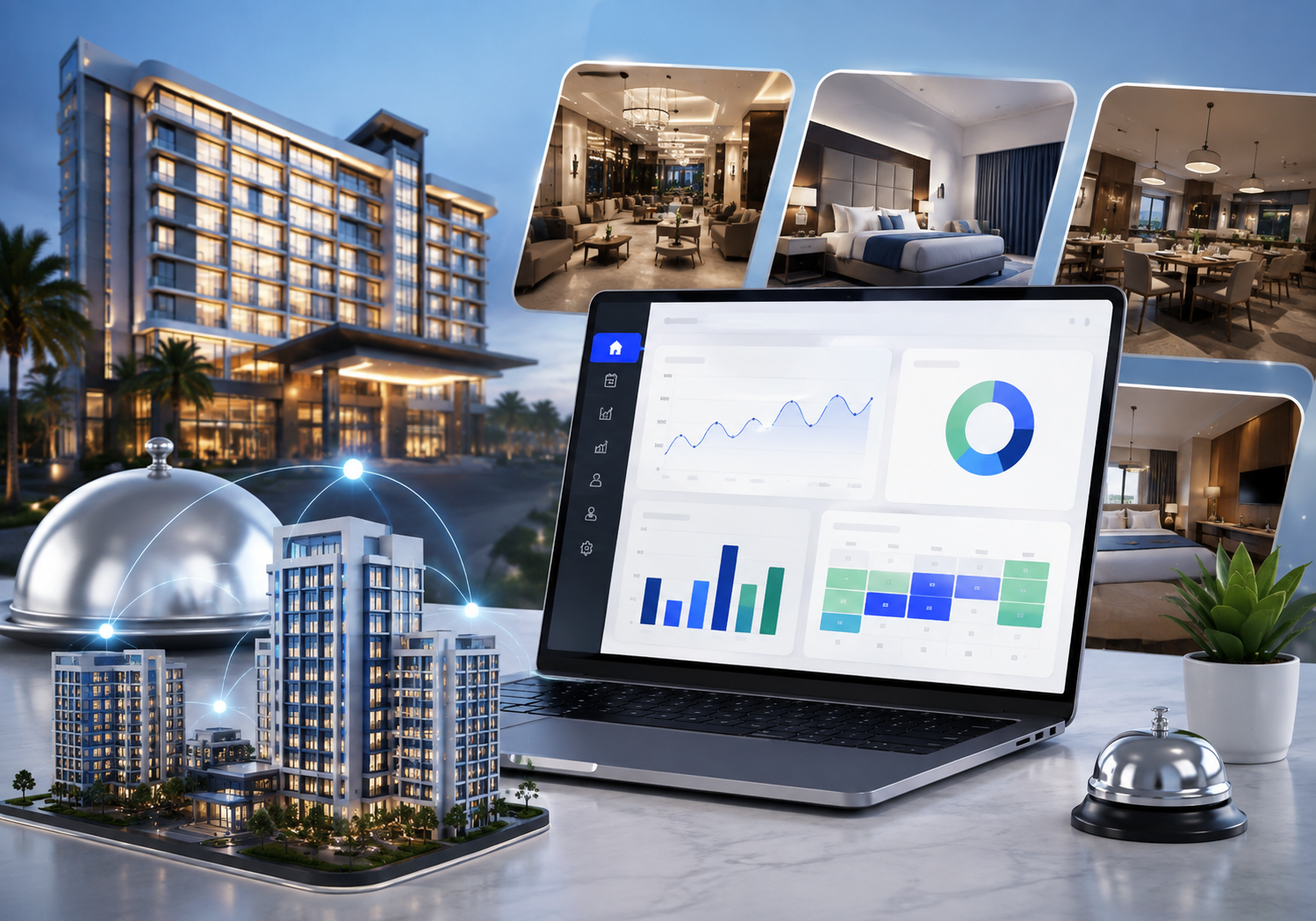
This category of software is a cloud platform built for groups running two or more properties. It centralizes reservations, front desk, housekeeping, billing, OTA distribution, and reporting across every hotel a group operates. Instead of logging into separate systems per property, owners and general managers see everything from one dashboard.
This differs from single-property software in one key way. A standalone PMS handles one hotel well. A chain-ready platform needs cross-property visibility, consolidated reporting, and centralized rate control. Every property stays connected under one login, one rate strategy, and one brand standard.
Why Hotel Chains Need Centralized Software in 2026 📈
Indian hospitality groups are expanding fast this year. Domestic travel sits at record highs. Tier-2 and tier-3 cities are opening new properties monthly. Groups still running each property in isolation cannot scale profitably.
Centralized control now separates growing chains from struggling ones. Guests compare consistency across every property they book with you. A guest staying at your Goa property expects the same booking ease at your Rishikesh location. Disconnected systems break that expectation quietly, and repeat guests notice fast. Brand trust erodes property by property when systems disagree.
📊 The Numbers Hotel Chains Should Know
- 🌍 SaasAro connects properties to 200+ OTAs from one login
- 💸 Direct bookings avoid 15–25% OTA commission per reservation
- ⚡ Most groups go fully operational within 24–72 hours
- 🏨 SaasAro is trusted by 10,000+ properties across India
Common Mistakes Hotel Chains Make ⚠️
Many groups scale properties faster than they scale their technology. A second or third hotel often launches on the same manual spreadsheet as the first. Staff copy rates between OTA extranets by hand, property by property. This habit quietly causes rate mismatches that guests notice immediately.
Another common mistake is treating each property as fully independent. Separate logins mean owners cannot compare performance across the portfolio. Slow reporting delays pricing decisions during festival or wedding season demand spikes. A third mistake is choosing software built only for single properties, then outgrowing it within a year. Fixing all three mistakes usually starts with one centralized platform, not five disconnected tools.
Core Features Every Hotel Chain Needs ✅
A true chain-ready platform needs specific capabilities single-property tools simply skip.
- 🏢 Multi-property dashboard — switch between properties instantly from one login
- 🔄 Centralized channel manager — sync rates and inventory across every OTA, every property
- 💹 Group-wide revenue management — apply pricing rules across locations in one action
- 📊 Consolidated reporting — compare occupancy and RevPAR across the entire portfolio
- 🌐 Unified booking engine — one branded website drives direct bookings for every property
- 🧾 GST-compliant billing — consistent, compliant invoicing across every location
- 👥 Role-based staff access — general managers see their property, owners see everything
Multi-Property Management: The Real Foundation 🏙️
Multi-property management is the capability every hotel chain needs first. A general manager should switch between properties in seconds. Owners should never juggle separate logins just to check occupancy. This foundation also makes every other feature, from revenue tools to reporting, work correctly across the portfolio.
Our detailed guide on multi-property hotel software explains how this centralized control works day to day. Groups scaling across multiple cities can also see how SaasAro supports this. Our guide to global hotel management software is built specifically for hotel chains and multi-property groups.
Channel Manager, PMS, and CRS for Chains 🔗
Distribution gets complicated fast once a group crosses two or three properties. Each hotel still needs its own OTA connections. Rate strategy, though, should stay centralized across the whole portfolio.
This is exactly where the distinction between a PMS, a channel manager, and a CRS matters most. Our detailed breakdown of channel manager vs PMS vs CRS explains why hotel chains need CRS-level functionality specifically. A single-property channel manager alone is not enough for a growing group.
Hotel management software for hotel chains should sync every property to 200+ OTAs at once. One booking on any channel updates every other channel instantly. This eliminates the double-booking risk that grows sharply once a portfolio expands past a few properties.
Revenue Management Across Multiple Properties 💰
Revenue management gets exponentially harder across multiple hotels. A group cannot manually adjust rates for each property during a sudden demand spike. Dynamic pricing should apply group-wide rules while respecting local market conditions.
A Goa property during peak season and a Rishikesh property during Char Dham season need different pricing logic entirely. The right platform lets ownership set both strategies from one dashboard. Neither strategy should ever contradict the other. Seasonal calendars, festival dates, and local events all need their own rate rules within the same system.
Direct Bookings and the Booking Engine 🚀
OTA commissions quietly drain profit across an entire portfolio. Every property paying 15–25% commission compounds fast once multiplied across ten or fifteen locations. A strong booking engine turns each property website into a commission-free channel.
Shifting even 15% of bookings direct recovers significant revenue annually. That effect multiplies across every property inside the chain, not just one location. Over a full year, the savings become substantial for the whole group. A unified booking engine also keeps brand design consistent across every property page.
Cost Considerations for Growing Hotel Groups 💡
Cost naturally becomes a bigger question for a multi-property group. Custom-built enterprise software often makes sense only for very large branded chains. Most growing Indian hotel groups get better value from a cloud platform priced per property instead. Predictable per-property pricing also makes budgeting far easier for finance teams.
Our detailed hotel management software cost guide breaks down pricing models for single properties and multi-property portfolios. Ownership can budget accurately before committing to any vendor.
Choosing the Right Platform for Your Chain 🧭
Choosing the right platform means comparing real capabilities, not marketing claims. Vendors differ sharply on OTA count, multi-property tools, and support quality. Our side-by-side SaasAro vs AxisRooms comparison shows exactly where platforms diverge for growing hotel groups.
Reading a comparison before signing any contract protects your group from a costly switch later. Ask every vendor for references from hotel chains, not single independent properties.
Why SaasAro Fits Growing Hotel Chains 🌟
SaasAro was built for exactly this challenge. Trusted by 10,000+ properties, SaasAro combines a PMS, channel manager, booking engine, and revenue tools inside one platform. Multi-property dashboards let general managers and owners work from the same real-time data.
Our complete guide to the best hotel management software covers every module in detail. Coverage spans front desk automation to group-wide reputation management. Full pricing details for growing portfolios sit on our pricing page.
SaasAro’s onboarding team handles OTA connections, data migration, and staff training across every property. Most groups go fully operational within days, not months. No technical background is required from any property’s team.
Switching Platforms Without Disrupting Operations 🔄
Many owners delay switching software because they fear disruption during migration. A well-run onboarding process avoids this entirely. Data migration happens property by property, not all at once across the group. Staff keep using existing workflows until each property’s new dashboard is fully tested and confirmed live.
SaasAro’s team runs this migration directly, so front desk staff are never left guessing mid-shift. Bookings already in the system transfer automatically, including rates, guest details, and OTA connections. Most owners report zero missed reservations during a properly managed switch.
Frequently Asked Questions ❓
Q1: What is hotel management software for hotel chains?
It is a cloud platform that centralizes reservations, distribution, billing, and reporting across every property. A hotel group manages everything from one dashboard.
Q2: How is it different from single-property hotel software?
Single-property software manages one hotel well. Chain-ready platforms add cross-property visibility, consolidated reporting, and centralized rate control across locations.
Q3: Can one dashboard really manage multiple hotel brands?
Yes, Role-based access lets owners see the full portfolio while general managers see only their assigned property.
Q4: Does this software prevent double bookings across properties?
Yes, Real-time OTA sync updates every channel instantly the moment any property confirms a booking.
Q5: How much does hotel management software cost for a chain?
Pricing typically scales per property and room count. Our cost guide breaks down exact ranges for portfolios.
Q6: How long does onboarding take for a multi-property group?
Most SaasAro hotel groups go live within days. The onboarding team handles setup for every property directly.
Q7: Is a CRS necessary alongside a PMS and channel manager?
Not always, An integrated platform often bundles CRS-level distribution, so a separate standalone CRS becomes unnecessary.
The Bottom Line 🎯
Growing a hotel group without centralized technology means losing revenue quietly, every day, across every property. The gap between chains running unified software and chains still using spreadsheets keeps widening in 2026. Portfolios that centralize now compound that advantage for years ahead. The right platform pays for itself through prevented double bookings alone, long before counting the direct-booking revenue it recovers. Ownership teams that act on this in 2026 gain a real head start over competitors still comparing spreadsheets across properties.
👉 Book a free SaasAro demo today and see the dashboard live.
📞 Call +91 75000 87037 to speak with the team directly.