
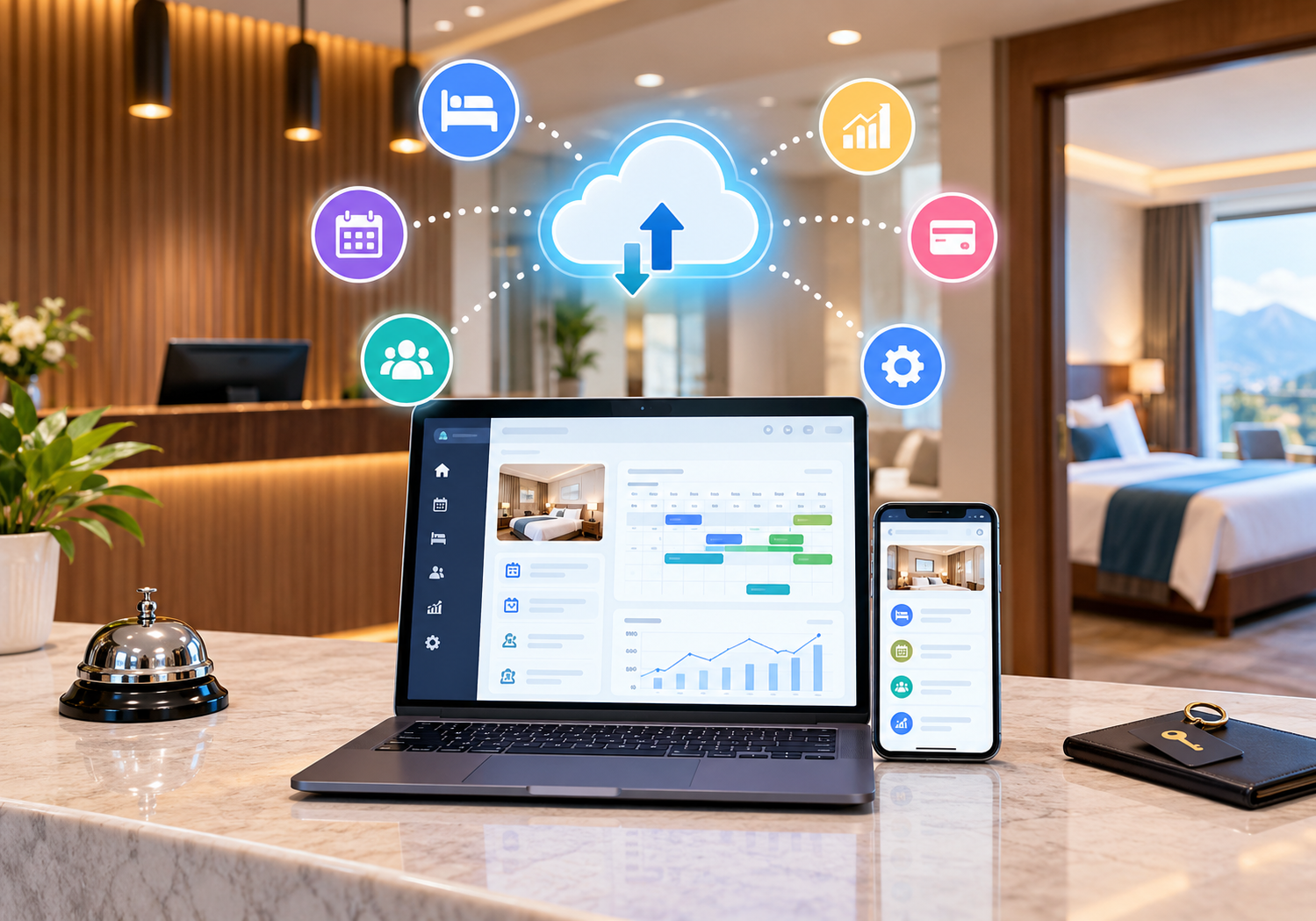
Cloud based hotel management software gives you one screen to run your entire property. 🏨 You can check rooms, rates, and bookings from any phone or laptop. No servers, expensive installs or waiting for IT support. Hotel owners across India are switching fast. In this guide, I share what works, what to avoid, and how to choose wisely. ✅
Why Hotels Are Moving to the Cloud in 2026 🚀
Old desktop systems are slow and hard to update. They only work at the front desk. Owners cannot see numbers when they travel. Staff waste hours on manual entries. Errors follow.
Guests have changed too. They book on phones at midnight, expect instant confirmation and compare five hotels in five minutes. A slow property loses the booking.
Cloud systems solve these problems. Your data lives on secure servers. Every update happens automatically. You log in from anywhere with internet. Small hotels now get tools that once only big chains could afford.
What Is Cloud based hotel management software? 🤔
Cloud based hotel management software is a web-hosted platform that runs your daily hotel operations. It replaces registers, spreadsheets, and disconnected apps. Everything sits in one dashboard.
Think of it as your digital front office. It handles reservations, check-ins, billing, housekeeping, and reports. Your team logs in through a browser or app. Changes appear instantly for everyone.
The vendor manages hosting, security, backups, and updates. You pay a simple subscription. You never buy servers or worry about crashed machines.
Core Modules Every Hotelier Should Know 🧩
A complete platform brings several tools together. Here is what each one does for you.
1. Property Management System (PMS) 🛎️
The PMS is your operational heart. It manages reservations, room status, guest profiles, and invoices. A good PMS cuts front desk time sharply. Explore the SaasAro property management system.
2. Channel Manager 🔗
A channel manager syncs rates and availability across booking sites. It stops double bookings before they happen. SaasAro connects with 200+ OTAs. See how the channel manager works. For a deeper read, try our guide on the channel manager for hotels.
3. Booking Engine 💻
Your own website needs a booking engine. Guests book direct and you skip heavy commissions. Learn more about the booking engine.
4. Revenue Management 📈
Smart pricing lifts income. The system studies demand, seasons, and local events. It suggests better rates daily. Read more about revenue management.
5. Housekeeping and Reports 🧹
Housekeeping tools show which rooms are clean, dirty, or blocked. Reports show occupancy, revenue, and channel performance. Visit the housekeeping and reports pages for details.
6. Reputation Management ⭐
Reviews shape bookings. This module collects guest feedback and helps you respond fast. See reputation management.
Top Benefits You Will Notice 🎯
Let me be direct. Software is only worth it if it saves money or grows income. Here is where cloud tools deliver.
- Lower upfront cost. There is no server purchase. You pay monthly and scale as you grow.
- Access from anywhere. Owners can approve rates from a beach, a train, or home.
- Real-time data. Every booking, payment, and room change updates instantly.
- Fewer errors. Automation removes manual typing, and typing causes most mistakes.
- Automatic updates. New features arrive without downtime or extra fees.
- Better security. Reputed vendors use encryption and daily backups. Most small hotels cannot match this alone.
- Higher direct bookings. A connected booking engine helps you win guests without paying OTA commission.
Cloud vs On-Premise Software: A Quick Comparison ⚖️
| Factor | Cloud Based | On-Premise |
|---|---|---|
| Setup cost | Low | High |
| Access | Anywhere online | Only on site |
| Updates | Automatic | Manual, paid |
| Backups | Daily, automatic | Your responsibility |
| Scaling | Easy | Needs new hardware |
| Maintenance | Vendor handles it | Needs IT staff |
The table shows a clear pattern. Cloud wins on cost, flexibility, and peace of mind. On-premise only makes sense for very specific legacy setups.
Who Benefits Most? 🏩
Every property type gains value. The needs differ slightly.
Small hotels and homestays get automation without hiring extra staff. Resorts get better control over rooms, restaurants, and activities. Read our guide on hotel management software for resorts.
Chains and group owners see every property in one view. Compare branches, rates, and revenue easily. Explore multi-property management. Also read our post on hotel management software for hotel chains.
A Day in the Life with a Cloud System ☀️
Picture a normal Tuesday at a 30-room hotel. At 7 AM, the owner opens the dashboard on a phone. Last night’s occupancy and revenue are already there.
At 10 AM, a guest books through the website. The room blocks on every OTA within seconds. Nobody calls the front desk to fix availability.
At noon, housekeeping marks rooms clean on a tablet. The front desk sees the update instantly. Early check-ins become easy.
By evening, the accountant downloads GST-ready invoices. The manager reviews channel performance. Everyone works from the same data, so nobody argues about numbers. 🙌
Reports That Actually Help You Decide 📊
Data is useful only when you act on it. A good platform shows the right numbers clearly.
- Occupancy rate by day, week, and month.
- Average daily rate across room types.
- Revenue by channel, so you know your best source.
- Cancellation trends that reveal weak spots.
- Guest source and repeat visit patterns.
Review these numbers every week. Small changes in pricing or promotion often bring quick gains.
Payments, GST, and Compliance in India 🧾
Indian hotels face specific rules. GST slabs depend on room tariffs. Invoices must be accurate and traceable. Manual billing makes mistakes easy.
A cloud platform applies tax rules automatically. It generates clean invoices in seconds. It also stores records safely for audits.
Online payment links help too. Guests can pay advances before arrival. This reduces no-shows and improves cash flow. Always confirm that your vendor updates tax rules when regulations change. 🇮🇳
How to Choose the Right Platform ✅
Many owners pick software based on a demo alone. That is risky. Use this checklist instead.
- Check if it includes a PMS, channel manager, and booking engine together.
- Confirm the number of OTA connections.
- Ask about Indian GST billing support.
- Test the mobile experience yourself.
- Read the support terms.
- Ask about phone and WhatsApp help.
- Request references from similar properties.
- Look for clear pricing with no hidden charges.
Our comparison of the best hotel management software explains what to weigh. It also helps to understand how a channel manager, PMS, and CRS differ. Read the full breakdown: channel manager vs PMS vs CRS.
What Does It Cost? 💰
Pricing depends on room count, modules, and support level. Most vendors charge monthly or yearly. Some bill per room. Others bundle plans.
Watch for setup fees, training fees, and integration charges. Ask for a written quote. Compare total yearly cost, not just the monthly headline.
For a full breakdown, read our hotel management software cost guide. You can also view plans and pricing.
Step-by-Step Rollout Plan 🛠️
A smooth launch avoids stress. Follow these steps.
Step 1: List your daily pain points. Note double bookings, slow billing, and missed reviews.
Step 2: Pick three must-have features. Do not chase every shiny option.
Step 3: Gather your data. Prepare room types, rates, taxes, and guest lists.
Step 4: Train your team in short sessions. Start with front desk staff.
Step 5: Run a small pilot. Use the system for one week alongside your old process.
Step 6: Go fully live. Review reports weekly and adjust.
Most teams settle in within a few weeks. Good vendor support makes this much easier.
Common Mistakes to Avoid ⚠️
- Choosing the cheapest option without checking features.
- Skipping staff training.
- Ignoring data security questions.
- Not testing the channel manager sync.
- Forgetting to import old guest data.
- Never reviewing reports after launch.
Small errors here can cost real bookings. A little planning goes a long way.
How Cloud Software Builds Trust with Guests 🤝
Trust matters in hospitality. Guests share IDs, phone numbers, and payment details. Your system must protect them.
A cloud platform uses encrypted connections. It keeps role-based access, so staff see only what they need. Daily backups protect you from data loss.
Fast service builds trust too. Quick check-ins, accurate bills, and clear communication make guests return. Technology supports these moments quietly in the background.
Why Support Matters More Than Features 📞
Features look great in a brochure. Support decides your daily experience. When a booking fails at 9 PM, you need help fast.
Ask vendors about response time, training, and onboarding help. Check if support speaks your language. Local Indian support makes a big difference during peak season. A friendly team that answers quickly protects your revenue and your reputation. 💬
My Practical Advice as a Hospitality Content Specialist 🧠
I work with hotels and SaaS brands across India. One pattern repeats often. Owners delay software because change feels hard. Then they lose bookings to properties that respond faster.
Start small. Automate room availability first. Then add billing and reports. Growth becomes simple when the base is strong.
Remember that tools do not replace hospitality. They free your team to focus on guests. That is the real win.
Frequently Asked Questions ❓
Q1. What does a cloud PMS do for a hotel?
It is a web-hosted system that manages reservations, billing, rooms, and reports. You access it through the internet. The vendor handles hosting and updates.
Q2. Is cloud software safe for hotel data?
Yes, when the vendor uses encryption, backups, and access controls. Always ask about security practices before signing.
Q3. Can small hotels use cloud based hotel management software?
Absolutely. Homestays and boutique stays use it daily. Monthly plans make it affordable. Small properties often see the biggest time savings.
Q4. Does it work if my internet is slow?
You need a stable connection. A basic broadband line is usually enough. Keep a mobile hotspot as backup.
Q5. How long does setup take?
Most properties go live within a few weeks. Timing depends on room count and data readiness.
Q6. Can it reduce OTA commissions?
Yes, indirectly. A booking engine on your website drives direct bookings. Direct guests cost far less than OTA guests.
Final Thoughts 🌟
Cloud based hotel management software is no longer a luxury. It is the base for smooth operations, happier guests, and steady growth. Start with your biggest pain point. Choose a partner who supports you after the sale. Then let the system do the heavy lifting.
Ready to modernise your property? 🚀
🎁 Book Your FREE Demo
📞 Call Us: +91 75000 87037