
A hotel channel manager is no longer a luxury — it is a necessity for every property that sells rooms across multiple online platforms. Whether you run a boutique guesthouse in Jaipur, a budget hotel in Pune, or a resort in Goa, the way you manage your online distribution directly impacts your revenue, your reputation, and your sanity.
Yet, thousands of hotel owners across India still manage their OTA listings manually — logging into MakeMyTrip, Booking.com, Agoda, Airbnb, and Goibibo one by one, updating rates, adjusting availability, and hoping nothing goes wrong. This approach costs time, causes errors, and silently drains revenue every single day.
If you are wondering whether your property is ready for smarter technology, read these five signs carefully. Any one of them is reason enough to act. All five together? You need a hotel channel manager today.
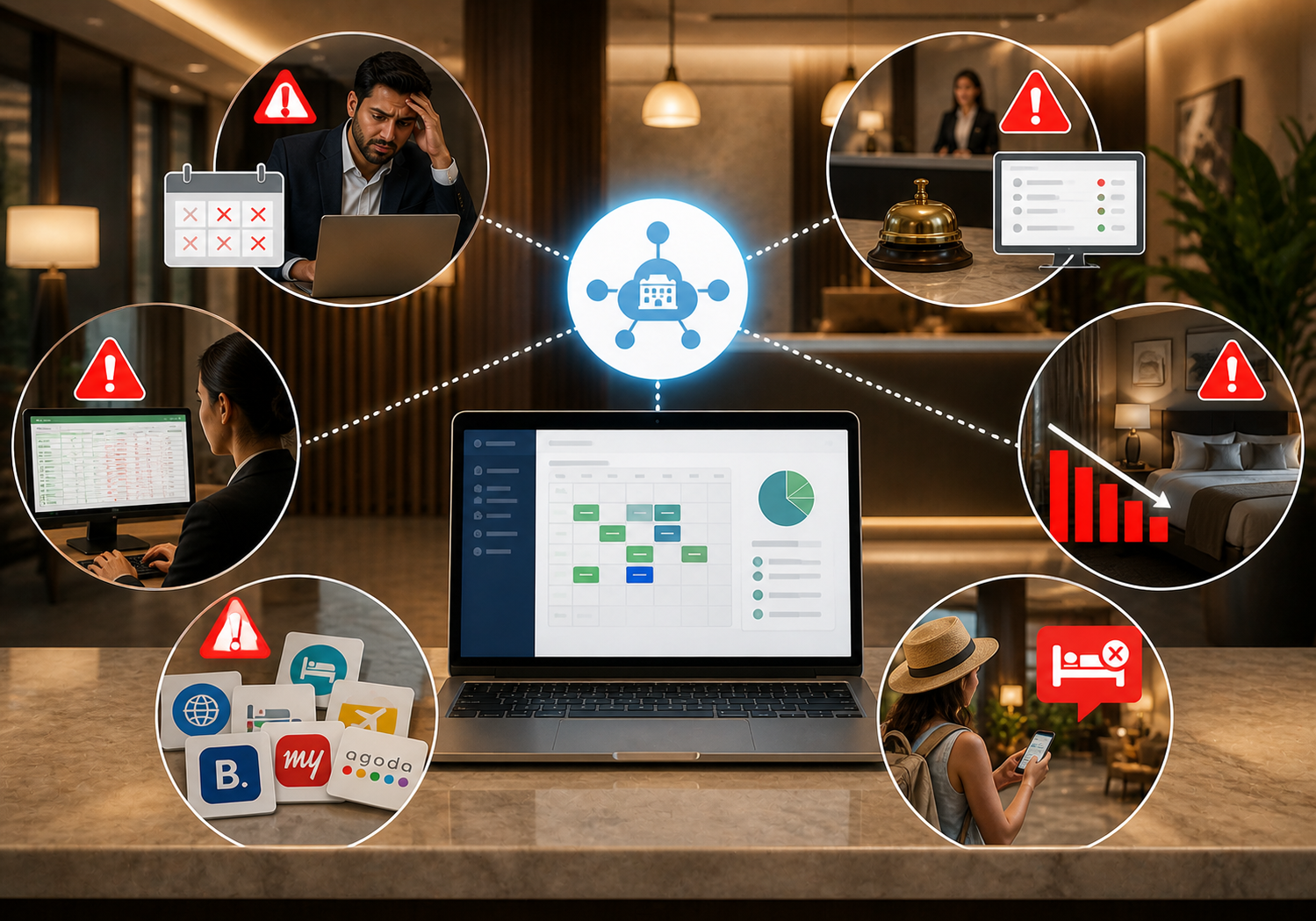
What Is a Hotel Channel Manager?
Before we get into the signs, let us quickly cover the basics.
A hotel channel manager is software that connects your hotel to multiple Online Travel Agencies (OTAs) from a single dashboard. When a guest books a room on Booking.com, the system automatically updates availability across every other platform — Expedia, MakeMyTrip, Airbnb, and more — in real time.
It eliminates manual updates, prevents double bookings, and ensures your pricing stays consistent everywhere guests search for your property.
Now, let us look at the five signs that tell you it is time to get one.
Sign #1: You Are Getting Double Bookings
Double bookings are the clearest and most damaging sign that your hotel needs a hotel channel manager immediately.
Here is how it happens: A guest books your last available room on MakeMyTrip at 11:00 PM. Before you wake up and manually update your other OTA listings, a second guest books the same room on Booking.com at 7:00 AM. You now have two confirmed guests and one room. The result is an angry cancellation, a bad review, and lost trust.
This is not a rare scenario. Hotels that manage availability manually face this problem regularly, especially during peak seasons, long weekends, and festive periods when booking velocity is high.
A hotel channel manager solves this automatically. The moment a booking comes in from any platform, it pushes a real-time availability update to every connected OTA. No delay, manual intervention and double booking.
If you have experienced even one double booking in the last six months, your current process is already failing you. A hotel channel manager removes this risk entirely.
Sign #2: You Spend Hours Every Day Updating OTA Listings Manually
Think about how much time your front desk team spends managing OTA listings right now.
Log into MakeMyTrip. Update room availability. Log into Goibibo. Match the rates. Log into Agoda. Update the inventory. Log into Airbnb. Check for discrepancies. Log into Booking.com. Repeat.
For hotels connected to even three or four OTAs, this process can consume two to four hours per day. That is time your team could spend improving guest experience, handling check-ins, upselling services, or simply reducing errors at the front desk.
A hotel channel manager eliminates this entirely. You make one change on your central dashboard, and the system pushes it to every connected OTA simultaneously. Rate updates, availability blocks, and promotional pricing go live across all platforms in seconds.
The math is simple. If your front desk staff spends two hours daily on manual OTA updates at even a modest hourly cost, you are wasting significant operational resources every month — resources that a hotel channel manager pays back within weeks.
If your team dreads opening OTA dashboards every morning, that is sign number two.
Sign #3: Your Room Rates Are Inconsistent Across Platforms
Rate parity — keeping your room prices consistent across all booking platforms — is one of the most important disciplines in hotel revenue management. OTA contracts often require it. Guests expect it. And inconsistent pricing creates trust problems that directly hurt your conversion rates.
Without a hotel channel manager, maintaining rate parity is nearly impossible at scale.
Here is what typically happens: You raise rates for a high-demand weekend on MakeMyTrip and Booking.com but forget to update Agoda. A guest finds your property cheaper on one platform, books it, and leaves a review mentioning the price difference. Other guests lose confidence in your pricing. OTA algorithms may flag your property for rate violations.
Worse, if your rates are accidentally lower on one platform, you end up attracting bookings at undervalued prices and losing revenue you should have earned.
A hotel channel manager keeps all your rates in sync from one place. You set your pricing rules once, and the system applies them uniformly across every connected OTA. Seasonal pricing, last-minute discounts, long-stay rates — all of it stays consistent everywhere.
If you have ever discovered that your rates differ across platforms without meaning them to, sign number three applies to you.
Sign #4: You Are Missing Peak Season Revenue Opportunities
Peak seasons — Diwali, New Year, summer holidays, major local events — are when hotels can significantly increase their revenue through dynamic pricing. These are the windows when demand surges and guests are willing to pay premium rates.
But capturing that revenue requires speed and precision. You need to raise rates quickly as demand climbs, and pull back availability on lower-margin OTAs as your rooms fill up. Manual management simply cannot keep pace.
Hotels without a hotel channel manager often leave peak-season money on the table in two ways:
First, they fail to raise rates fast enough. By the time they manually update all their OTA listings, competitors with automated systems have already captured the high-value bookings at premium prices.
Second, they maintain the same room count across all OTAs even as occupancy fills up. They end up paying OTA commissions on rooms they could have sold directly or at better margins through alternative channels.
A hotel channel manager gives you the speed and control to respond to demand in real time. You can instantly block inventory on high-commission OTAs once you hit a target occupancy, create flash promotions on low-demand days, and adjust rates across all platforms in one action.
During peak season, this kind of agility is the difference between a good month and a great one. If you feel like you are always reacting too slowly to demand shifts, sign number four is yours.
Sign #5: You Have No Clear View of Your Bookings in One Place
Ask yourself this: Right now, without opening five different browser tabs, can you tell exactly how many rooms are booked for next Saturday? Which OTAs generated those bookings? What your current revenue looks like versus the same week last month?
If the answer is no, your hotel is operating blind.
Hotels that rely on manual OTA management have no unified view of their business. Booking data lives in separate OTA dashboards. Revenue figures need to be manually compiled from multiple sources. Performance trends are invisible until someone spends hours pulling reports together.
This lack of visibility has real consequences. You cannot identify which OTAs are delivering the best net revenue after commissions, can’t spot booking pace trends early enough to respond with pricing adjustments, can’t make confident decisions about your distribution strategy because you simply do not have the data in one place.
A hotel channel manager solves this by feeding all your booking data into a single dashboard. Every reservation, every cancellation, every modification — from every OTA — appears in real time in one view. You can instantly see your occupancy, track channel performance, and make decisions based on facts rather than guesswork.
When your business intelligence is fragmented across platforms, you cannot manage revenue effectively. Sign number five is perhaps the most important of all.
How SaasAro’s Hotel Channel Manager Solves All Five Problems
SaasAro is a complete hospitality management platform built specifically for independent hotels, guesthouses, B&Bs, and small hotel chains across India.
The SaasAro hotel channel manager connects your property to 100+ OTAs — including MakeMyTrip, Booking.com, Agoda, Goibibo, Airbnb, Expedia, Cleartrip, Yatra, and more — and manages everything from one central dashboard.
Here is what SaasAro delivers:
Real-time sync across all OTAs — The moment a booking arrives from any platform, SaasAro updates availability everywhere else in seconds. Double bookings become impossible.
One-click rate management — You set your pricing once, and SaasAro pushes it consistently to every connected OTA. Rate parity is automatic, not manual.
Centralized booking dashboard — Every reservation from every platform appears in one place, giving you a complete, real-time view of your business.
Deep integration with SaasAro PMS — Your channel manager connects directly to your property management system. Front desk, housekeeping, billing, and distribution all talk to each other seamlessly.
Revenue management tools — SaasAro helps you set dynamic pricing rules, block OTA inventory strategically, and identify your highest-value booking channels.
Thousands of hotel owners across India trust SaasAro to run their distribution — and they consistently report fewer errors, more bookings, and saved hours every week.
Frequently Asked Questions (FAQ)
Q1: What exactly does a hotel channel manager do?
A hotel channel manager connects your hotel to multiple OTAs from one dashboard. It automatically updates room availability and rates across all platforms in real time whenever a booking is made, modified, or cancelled.
Q2: Is a hotel channel manager suitable for small hotels and guesthouses?
Yes, A hotel channel manager is especially valuable for small and independent properties. These hotels often have limited staff and cannot afford the time or errors that come with manual OTA management. SaasAro offers plans designed specifically for small properties across India.
Q3: How quickly does the SaasAro hotel channel manager sync availability across OTAs?
SaasAro syncs availability across all connected OTAs in real time — typically within seconds of a booking being confirmed on any platform.
Q4: Will a hotel channel manager help me get more bookings?
Yes, A hotel channel manager helps you maintain accurate availability and consistent pricing across more platforms simultaneously. This increases your visibility, reduces booking errors, and allows you to respond faster to demand — all of which drive more bookings.
Q5: Can SaasAro’s hotel channel manager integrate with my existing PMS?
SaasAro’s hotel channel manager is built as part of a fully integrated platform. It connects natively with SaasAro’s PMS, booking engine, revenue management tools, and reporting dashboard — giving you a complete end-to-end solution.
Q6: How soon can I go live with SaasAro’s hotel channel manager?
SaasAro’s onboarding team can get your property connected and live within 48 hours. The platform is designed for quick setup with dedicated support throughout the process.
Final Thoughts
A hotel channel manager is not just a technology upgrade — it is the foundation of a professional, scalable hotel distribution strategy. If you recognised even one of the five signs in this article, your property is already losing time, money, or both to manual processes.
The good news is that fixing it is straightforward. SaasAro’s hotel channel manager gives you real-time OTA sync, centralized booking management, and the revenue tools to grow your occupancy confidently.
Stop managing five dashboards manually. Start managing your hotel from one.