
Cloud PMS adoption is rising fast across India’s hotel industry. Every hotel owner eventually faces the same big decision. Should they run a traditional server-based system? Or move their property management system online instead? This single choice shapes daily operations, guest experience, and long-term costs. In this guide, we compare Cloud PMS and on-premise PMS in plain language. You will learn the real differences in cost, security, and scalability. By the end, you will know exactly which system suits your property. This guide draws on real deployment patterns seen across Indian hotels of every size, from budget guesthouses to large chains.
Why trust this guide? Hospitality technology teams work directly with independent hotels, boutique properties, and multi-location chains across India every day. This comparison reflects patterns seen in real front-desk operations, not just theory. We stay neutral about hardware-based setups too, since some larger properties genuinely need them.
🖥️ What Is a Hotel PMS?
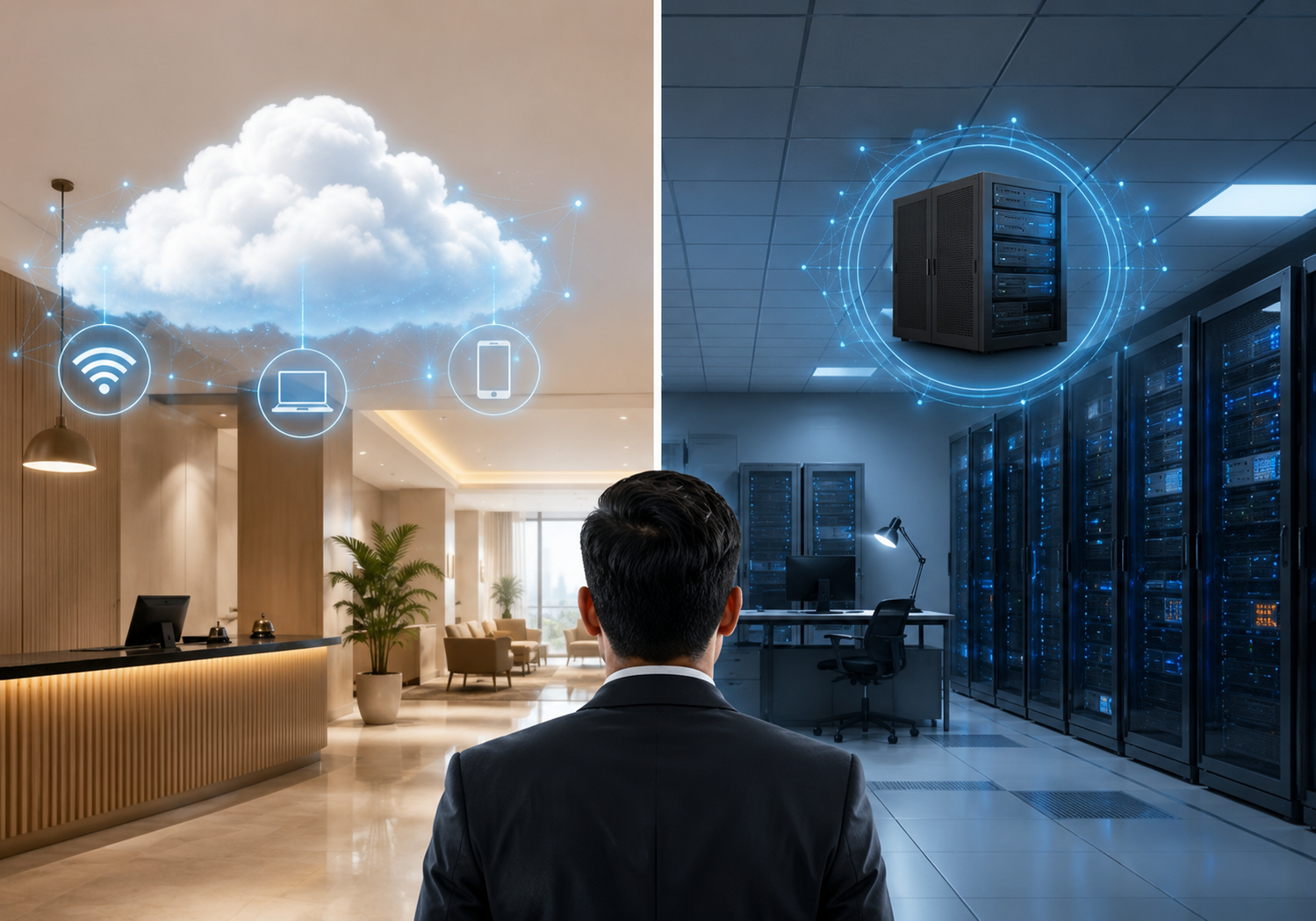
A Property Management System, or PMS, runs your hotel’s daily operations. It handles reservations, check-ins, checkouts, billing, and housekeeping tasks. A capable PMS software connects your front desk to every department. Without it, staff juggle spreadsheets, phone calls, and paper registers daily. Hotels generally choose between two deployment models today. One installs software on a physical server inside the property. The other, delivered as Cloud PMS, runs entirely through the internet. Understanding both models helps you make a confident, informed choice.
🏢 What Is On-Premise PMS?
On-premise PMS runs on a physical server inside your hotel building. Your IT team installs the software directly onto local machines. You own the hardware, and you manage every update yourself. This model was the industry standard for many decades. Large legacy hotel chains often still rely on it today. However, on-premise systems demand heavy upfront investment from owners. You pay for servers, software licenses, and dedicated IT staff. Security patches, backups, and hardware repairs also become your job. If the server room floods or the power fails, operations can stop completely.
Typical on-premise costs include:
- Server hardware and installation 🖥️
- Annual software licensing fees 📄
- In-house IT support salaries 👨💻
- Manual data backup infrastructure 💾
☁️ What Is Cloud PMS?
Cloud PMS stores your hotel data on secure, remote servers instead. You access it through any browser or mobile app, anywhere. There is no bulky software to install on local machines. This system updates automatically, so you always run the newest version. Most growing Indian hotels now prefer this model for its low setup cost. It also connects smoothly with a channel manager and booking engine. This keeps rates and room inventory synced across every OTA in real time. Staff can check guests in from a tablet at the lobby entrance too.
📊 Cloud PMS vs On-Premise PMS: Key Differences
The table below compares both systems across the factors that matter most.
| Feature | Cloud PMS ☁️ | On-Premise PMS 🖥️ |
|---|---|---|
| Setup Cost | Low, subscription-based | High, one-time hardware spend |
| Maintenance | Handled by the provider | Managed by your own IT team |
| Accessibility | Anywhere, on any device | Only from on-site computers |
| Software Updates | Automatic, usually free | Manual, often paid separately |
| Data Backup | Automatic, off-site backup | Manual backup, prone to gaps |
| Scalability | Simple to add new properties | Slow, expensive to expand |
| Internet Dependency | Required to operate | Works without a connection |
| Disaster Recovery | Data safe even if hardware fails | Data at risk during local damage |
| Best Suited For | Independent hotels, growing chains | Large hotels with strict local IT rules |
This model clearly wins on cost, flexibility, and long-term scalability. On-premise setups still offer tighter local control for select properties.
🚀 Benefits of Cloud PMS for Indian Hotels
A cloud-based PMS brings measurable advantages for hotels of every size.
- Lower upfront cost 💰 — skip expensive servers and hardware purchases entirely.
- Remote access 📱 — manage bookings and rates from your phone, anywhere.
- Automatic updates 🔄 — new features and fixes arrive without extra effort.
- Stronger integrations 🔗 — connects with OTAs, payment gateways, and revenue management tools.
- Multi-property support 🏘️ — run several hotels from one central login using multi-property management.
- Faster staff training 🎓 — cloud dashboards feel simpler for new front-desk hires.
- Built-in disaster recovery 🌪️ — guest data stays safe even during local outages.
These benefits explain why so many independent Indian hotels now prefer this approach.
⚠️ Challenges of Cloud PMS
Cloud PMS is not a perfect fit for every situation, however. It depends on a stable internet connection to run smoothly. Remote or rural properties may face occasional connectivity issues. Some owners also feel uneasy storing guest data off-site. Choosing a provider with enterprise-grade security resolves most of these worries. Reliable providers also offer offline check-in modes for brief outages.
🔒 Data Security and Compliance in Detail
Security concerns stop many hoteliers from switching too quickly. Established cloud providers use bank-grade encryption for guest data. They also run regular security audits and vulnerability testing. India’s Digital Personal Data Protection Act shapes how guest information must be stored. A trustworthy PMS partner keeps consent records and access logs transparent. Always ask any vendor for their security certifications before signing up. This single step protects your property from future compliance headaches.
🧮 Total Cost of Ownership: A Realistic Comparison
Sticker price rarely tells the full cost story for either model. On-premise PMS looks cheaper only in the first few months. Hardware depreciation, IT salaries, and license renewals add up quickly after that. A subscription-based system spreads these costs evenly across each month instead. Over three to five years, most independent hotels save meaningfully by avoiding hardware refresh cycles. Factor in staff time, downtime risk, and support response speed too.
🏛️ When On-Premise PMS Still Makes Sense
On-premise systems still fit certain hotels well. Large five-star properties with dedicated IT teams may prefer full local control. Hotels in areas with unreliable internet sometimes avoid cloud tools entirely. Government-linked or high-security properties may face strict data storage rules. In these specific cases, local servers offer predictable performance without depending on connectivity. That said, this control comes with a much higher ongoing cost. Hoteliers in this category should still review their setup every few years. Technology needs change fast, even for large, established properties.
🇮🇳 Indian Market Factors That Affect Your Decision
India’s hotel industry has unique needs that shape this choice directly. Internet infrastructure has improved massively across tier 2 and tier 3 cities. This makes Cloud PMS a realistic option almost everywhere today. Even smaller pilgrimage markets like Varanasi and Rishikesh now have strong connectivity. GST compliance also matters for every Indian hotel’s billing process. Most modern cloud platforms generate GST-compliant invoices automatically for every guest. Reputable providers follow strict data protection standards to stay compliant with Indian law. Budget matters too, especially for independent hotels and small regional chains. A cloud-based system spreads costs into manageable monthly payments instead of one large bill. This frees up working capital for renovations, marketing, or hiring. Domestic tourism is also growing steadily across smaller Indian cities and pilgrimage circuits. That growth pushes more independent properties toward flexible, subscription-friendly technology. Smartphone use among front-desk staff is also nearly universal now, even in smaller towns. This makes browser-based dashboards easy for teams to learn quickly, without long training cycles.
🔄 How to Migrate to a Cloud System: A Quick Checklist
Switching from an old, local setup does not need to feel risky.
- Export your existing data — guest history, rates, and inventory records first.
- Choose a provider with local support — Indian time zones and Hindi-language help matter.
- Run both systems briefly — a short parallel run catches mismatches early.
- Train staff in small groups — most front-desk teams adapt within a few days.
- Go live during a quiet period — avoid switching during peak festival season.
Most hotels complete this full transition within one to two weeks.
💡 Which One Should You Choose: Cloud PMS vs On-Premise PMS?
Your decision depends mainly on hotel size, budget, and location.
- Independent hotels and guesthouses — Cloud PMS suits low budgets and fast setup needs.
- Boutique hotels and small chains — Cloud PMS scales smoothly as you add properties, similar to multi-property setups.
- Large hotel chains with strict IT policies — On-premise PMS may still fit certain compliance needs.
- Properties in low-connectivity areas — Weigh both models carefully before committing.
For most Indian hotels today, Cloud PMS delivers stronger long-term value.
🏨 A Real-World Example
Picture a 25-room boutique hotel opening a second property nearby. With an on-premise system, the owner needs separate servers at each site. Both locations would also need their own IT support contracts. With a cloud-based system, both properties run from one shared, central dashboard. Staff at both hotels see live bookings, rates, and housekeeping status instantly. Management can review performance for both properties from a single reporting screen. This kind of flexibility is exactly why growing Indian hotel groups favor cloud platforms. Onboarding the second property also takes days, not months, since no new servers are needed.
✅ Final Thoughts
Cloud PMS gives Indian hotels lower costs, faster scaling, and true remote access. On-premise systems still work for large properties with strict local IT needs. Most independent hotels and small chains benefit more from a cloud-based switch. Before deciding, list your budget, internet reliability, and growth plans honestly. Then match those needs against what each PMS model genuinely offers. Trusted platforms already power thousands of properties across India’s hospitality market. Ready to explore a modern PMS built specifically for Indian hotels? Book a free SaasAro demo today and see the difference yourself.
❓ Frequently Asked Questions
1. What is the main difference between Cloud PMS and on-premise PMS?
Cloud PMS runs online with remote access, while on-premise PMS relies on local servers only.
2. Is Cloud PMS safe for Indian hotels?
Yes, Reputable cloud providers use encryption and follow strict data protection standards.
3. Does Cloud PMS work without internet access?
No, Cloud PMS needs a stable internet connection to function properly at all times.
4. Which option is cheaper, Cloud PMS or on-premise PMS?
Cloud PMS is usually cheaper upfront, since it avoids costly server hardware purchases.
5. Can Cloud PMS handle multiple hotel properties at once?
Yes, Most cloud platforms support multi-property management from a single dashboard.
6. Is Cloud PMS suitable for small, independent Indian hotels?
Yes, Its low cost and quick setup make it ideal for smaller properties.
7. How long does switching to a cloud-based system usually take?
Most Indian hotels complete a full switch within one to two weeks.
8. Does Cloud PMS support GST-compliant billing in India?
Yes, Most modern providers generate GST-compliant invoices automatically for every booking.
🎯 Ready to Upgrade Your Hotel’s PMS?
Choosing between Cloud PMS and on-premise PMS shapes your hotel’s next five years. Most Indian hotels today gain more from switching to a cloud-based system. Lower costs, remote access, and faster growth make the decision easier than it seems.
SaasAro’s Cloud PMS is built specifically for Indian hotels, from independent guesthouses to growing chains. Real-time OTA sync, GST-ready billing, and enterprise-grade security come standard, not as add-ons.
👉 Book Your Free Demo and see your new dashboard in minutes.
💬 Chat With Our Team on WhatsApp for instant answers.
💰 View Pricing Plans to find the right fit for your property.
Your hotel deserves technology that works as hard as your front desk team. 🏨✨