
A channel manager for OTAs keeps your rates and availability in sync everywhere guests search. List your hotel on Booking.com, Expedia, Agoda, or MakeMyTrip? You know the pain of updating each site by hand. One missed update can mean a double booking and an angry guest. In 2026, hotels still managing OTAs manually are losing revenue every single week. Studies show properties with automated distribution capture more direct and OTA revenue combined.
This guide is written for hotel owners, revenue managers, and front-desk teams juggling multiple OTAs. You will learn why your hotel needs one. You will also see which features matter most and how to pick a platform for 2026.
📞 Ready to stop juggling OTA extranets? Call SaasAro for a free demo. Or explore our Channel Manager built for Indian hotels.
What Is a Channel Manager for OTAs? 🤔
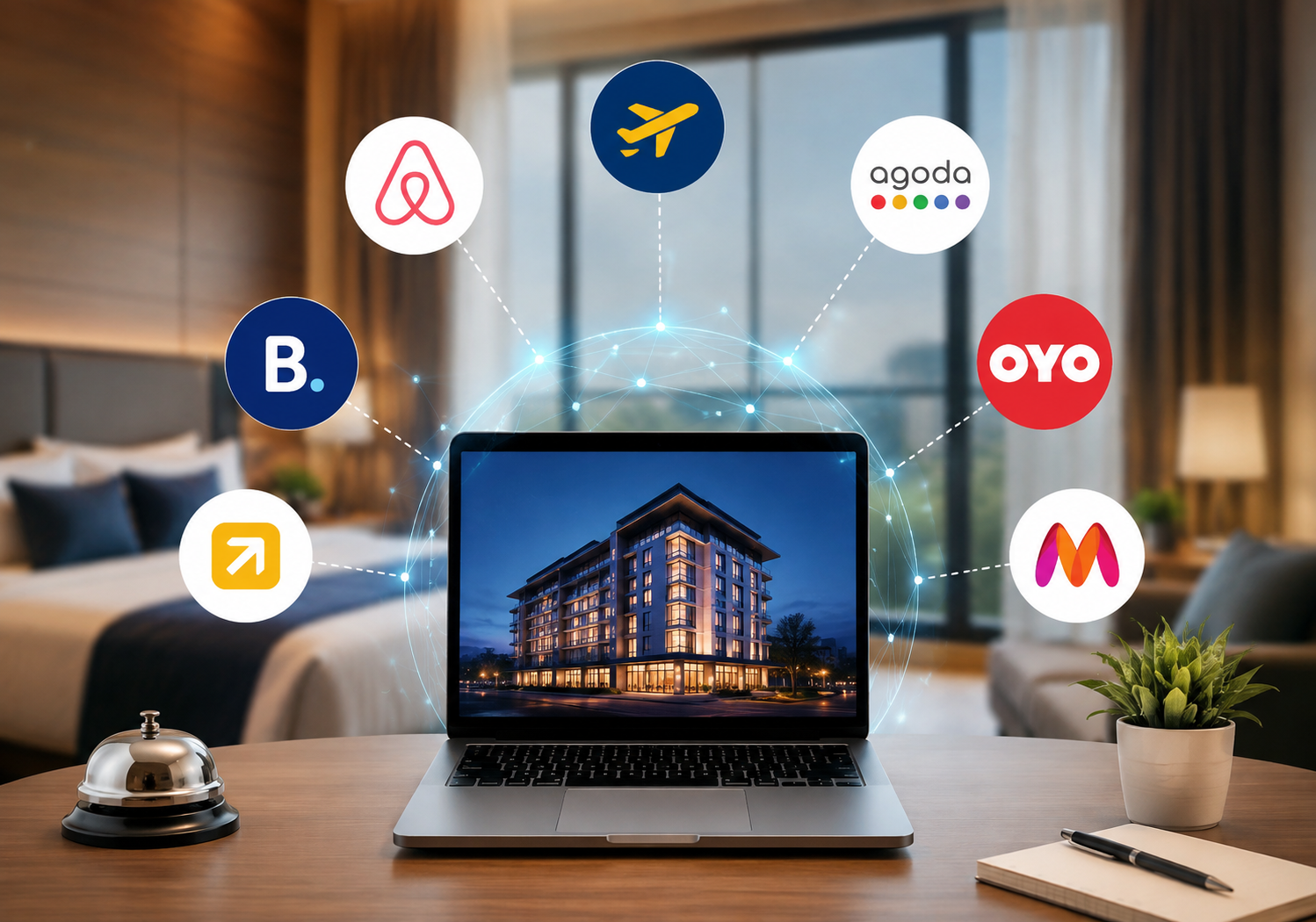
This software connects your property system to every travel platform you sell on. It pushes rate and inventory updates to all channels at once. When a room sells on one OTA, it blocks that room everywhere else instantly. This single sync point separates automated hotels from chaotic ones.
Most modern tools also connect with a property management system and a booking engine. That creates one unified dashboard for your entire operation. Front desk staff never need five different extranet logins to check a rate. Owners get one clean view of every channel instead of scattered spreadsheets.
Why Every Hotel Needs This in 2026 📈
Guests now compare prices across four or five platforms before booking. A tiny rate mismatch can cost you the sale. It can also trigger an OTA rate-parity penalty. Fast, synced updates remove that risk in seconds.
Distribution has also grown far more complex. Hotels today sell rooms through global OTAs, regional platforms, and their own website. Handling that by hand eats hours of staff time weekly. Human error is almost guaranteed during peak season rushes, especially around festivals and long weekends.
A strong channel manager for OTAs also feeds your revenue management strategy. It shows exactly which OTA drives bookings, at what price, and at what commission cost. That visibility helps owners make smarter pricing calls instead of guessing blindly. Over time, this data can guide which platforms deserve more inventory allocation.
Key Features to Look For ✅
Not every tool offers the same depth of automation. Check for these essentials before you choose one.
- 🔄 Real-time two-way sync with Booking.com, Expedia, and Agoda
- 🛡️ Automatic inventory blocking that prevents double bookings
- 📊 Built-in reports showing OTA-wise performance and commission spend
- 🏢 Support for multi-property management across several hotels
- 💬 Local support that understands Indian OTA nuances closely
- 🔌 Direct integration with your PMS and booking engine
- ⏱️ Fast onboarding, ideally live within a few business days
A true channel manager for OTAs needs two-way sync to work well. One-way sync still leaves staff checking each extranet by hand, which defeats the purpose of automation.
How This Stops Overbooking 🚫
Double bookings happen when one room sells on two platforms at once. This often occurs during busy weekends or festival periods. Those are exactly the times you can least afford the chaos.
A reliable channel manager for OTAs solves this with instant inventory locks. The moment a guest books anywhere, availability updates across every channel within seconds. There is no manual refresh and no risky delay window. For properties near festival destinations, this feature alone can save real money. It also protects your reputation from angry review posts and refund disputes. Our guide on channel manager setup in Varanasi covers this exact scenario in detail. Pilgrimage season creates unusually high demand spikes there.
Manual Updates vs Automated Sync ⚖️
Some smaller properties still rely on spreadsheets and manual logins. This can work with one or two OTAs and low occupancy. It collapses fast once you add a third or fourth channel.
Automated sync scales without extra effort. Whether you run five rooms or five hundred, the update logic stays identical. Staff time shifts from repetitive data entry toward guest service and upselling, which improves guest satisfaction scores too.
Common Mistakes Hotels Make ⚠️
Many owners connect a tool once and then forget about it entirely. Rate plans drift out of sync when staff forget to review mapping settings. Always double-check room type mapping after any OTA extranet update.
Another mistake is ignoring OTA-wise reports for months at a time. Owners often keep paying high commissions on channels that barely convert. Reviewing performance data monthly helps catch these issues early.
A third mistake is skipping staff training after the initial setup call. New front-desk hires often revert to old manual habits under pressure. A short refresher session every quarter keeps everyone aligned on the workflow.
Step-by-Step: How Setup Usually Works ⚙️
- Audit your current OTAs – List every platform, room type, and rate plan in use today.
- Map rooms and rates – Match each OTA listing to the correct room category in your system.
- Test with a blackout date – Block one date across all channels to confirm sync speed.
- Go live gradually – Activate one or two OTAs first, then add the rest over a week.
- Train your team – Walk front-desk and reservations staff through the new dashboard.
Most Indian properties complete this process within three to five business days.
Real-World Impact: A Quick Example 📊
Consider a 40-room property selling on five different OTAs during festival season. Before automation, staff spent nearly two hours daily updating each extranet manually. After switching to automated sync, that time dropped to under fifteen minutes. The saved hours went straight into guest service and upselling add-ons. Fewer manual updates also meant zero double bookings across that entire festival period. Occupancy accuracy across all five OTAs stayed above ninety-nine percent that season. Guest complaints related to booking errors dropped to almost zero by the season’s end.
SaasAro’s Channel Manager for OTAs 🇮🇳
SaasAro connects to 200+ OTAs, giving Indian hotels reach without added complexity. Our platform was built around Indian booking patterns and festival demand surges.
The dashboard combines rate updates, inventory control, and OTA reporting on one screen. It works alongside our house-keeping and intelligent learning modules. Front-desk operations and distribution stay fully connected as a result, which reduces daily coordination calls between departments.
Local support matters more than most owners expect at first. Indian OTA extranets often behave differently from global platforms during festival surges. Our support team understands these quirks and resolves issues quickly. Response times matter most during a rate glitch on a sold-out weekend. Regional language support also helps smaller-town properties onboard staff faster.
Rate Parity: A Quick Note ⚠️
Most OTAs require the same room rate across every channel you sell on. This is called rate parity, and breaking it can trigger penalties. Automated sync helps hotels stay compliant without tracking every clause by hand. It applies one rate change everywhere at once, reducing accidental mismatches. Always review each OTA contract for parity terms specific to your market. A few regional platforms allow small exceptions during festival promotions, so check the fine print carefully.
What Does This Typically Cost? 💰
Pricing usually depends on room count, number of connected OTAs, and support level needed. Many vendors charge a flat monthly fee rather than a per-booking commission. Smaller properties often pay less than larger multi-property groups with complex mapping needs. Setup fees are increasingly rare among modern Indian vendors in 2026. Always ask whether pricing scales with room count or stays fixed regardless of size. Our detailed hotel management software cost guide breaks down typical price ranges further.
Hotels comparing platforms often check our breakdown of hotel revenue management companies. Many also read our SaasAro vs AxisRooms comparison before deciding. Hotel groups can review our guide on software for hotel chains for centralized OTA control. Resort owners may prefer our resource on software for resorts instead.
How to Choose the Right Platform 🎯
Start by listing every OTA your hotel currently sells on. Include regional and niche platforms, not just the major names. Confirm the vendor supports two-way sync for each one.
Ask for a live demo rather than trusting a features brochure alone. Pricing matters too, so compare plans carefully before you commit. Our hotel management software cost guide can help with that comparison.
Check whether support runs in your time zone as well. OTA issues rarely happen during convenient business hours only. If you want a full software stack, our best hotel management software guide compares leading platforms in depth.
Key Takeaways 📝
- Manual OTA updates cause double bookings and lost revenue
- Two-way sync is non-negotiable for reliable automation
- Local support matters for Indian festival demand surges
- Review OTA-wise reports monthly to control commission costs
- Setup usually takes three to five business days
Frequently Asked Questions ❓
Q1. What does this software actually do for OTA listings?
It syncs your rates, availability, and bookings across every connected OTA in real time. No platform ever shows outdated numbers.
Q2. How many OTAs can SaasAro connect to?
SaasAro connects to 200+ OTAs, covering global giants and regional Indian platforms alike, from major cities to smaller tourist towns.
Q3. Does it replace my property management system?
No, It works alongside your PMS and booking engine as one connected system, not as a separate standalone tool.
Q4. Is this worth it for a small property?
Yes, Even ten-room hotels face double-booking risk once listed on three OTAs, so automation pays off fairly quickly.
Q5. Can it help lower OTA commission costs?
Indirectly, yes. Clear commission-wise data helps owners favor lower-cost, higher-value channels over time instead of guessing.
Q6. How long does setup usually take?
Most Indian hotels can go live within a few business days, depending on how many OTAs need mapping.
Q7. What happens if my internet connection drops?
Most platforms cache your last synced rates, so listings stay live until connectivity returns and syncing resumes.
Final Thoughts 🏁
Picking the right channel management tool is a high-leverage call for any hotel in 2026. It protects revenue, prevents overbooking, and frees staff for guest-facing work instead of extranet logins. The right platform pays for itself within a single busy season, often within the first festival rush alone.
📞 Talk to SaasAro today at +91 75000 87037. Or visit our pricing page to find a plan that fits your property.