
🔌 A channel manager API lets your PMS talk to many booking platforms through one connection. Without it, every OTA needs its own custom link. Also, that work is slow, costly, and hard to maintain. Therefore, smart software teams and hoteliers choose a single, reliable bridge. In this guide, you will learn how it works and why it matters. Let’s get started! 🚀
🧭 What Is a Channel Manager API?
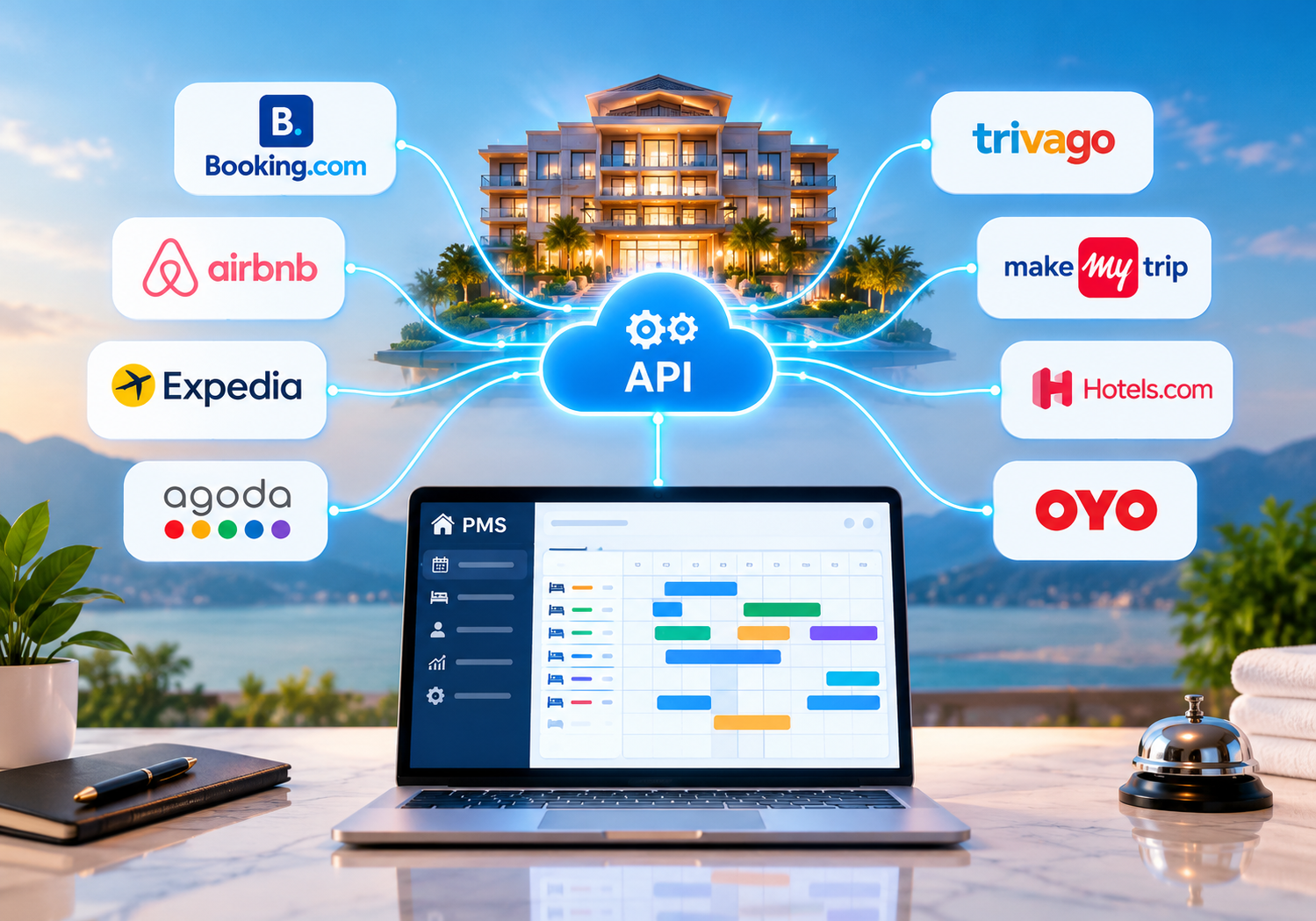
A channel manager syncs rates, rooms, and bookings across OTAs. An API is the secure doorway that lets other software use that sync. So, a channel manager API connects your PMS with the channel manager programmatically.
In simple terms, your PMS sends updates once. The channel manager then pushes them to every connected platform. Moreover, new bookings flow back into your PMS automatically.
SaasAro offers cloud-based tools for Indian hospitality businesses. Its channel manager API is meant to simplify this exact flow. Always confirm current features and supported platforms directly with SaasAro.
😓 The Hidden Cost of Direct OTA Integrations
Some PMS teams try to connect to every OTA directly. However, this sounds simple at first. Still, in practice, it becomes a heavy burden.
Here is what usually goes wrong:
- ❌ Many different formats: Each platform uses its own rules and data structure.
- ❌ Constant maintenance: Platforms change requirements, and your code must follow.
- ❌ Slow launches: Every new channel needs weeks of work.
- ❌ Certification effort: Platforms often require testing and approval.
- ❌ Support load: Your team handles every sync problem alone.
Consequently, developers spend more time fixing links than improving the product. Moreover, hotels suffer when updates fail. Hence, a shared integration layer saves time and risk.
⚙️ How a Channel Manager API Works
The flow is easy to picture. First, your PMS sits on one side. Meanwhile, the OTAs sit on the other. The channel manager API stands in the middle.
- Connect once. Your PMS links with the channel manager through the API.
- Map your data. Room types, rate plans, and properties match across systems.
- Send updates. Rates and availability go out from the PMS.
- Distribute widely. The channel manager passes them to each connected OTA.
- Receive bookings. Reservations return to the PMS through the same link.
- Sync changes. Cancellations and edits update everywhere.
This two-way flow keeps data accurate on every platform. Also, hotel staff see all bookings in one place.
💰 Benefits for Hotels
Because hotels use the system daily, they feel the gains first. Here is what a stronger link delivers:
- ✅ Fewer overbookings: One shared inventory protects every sale.
- ✅ Faster updates: Changes reach platforms within moments.
- ✅ Less manual work: Staff stop retyping rates on many sites.
- ✅ Better rate control: Prices stay consistent across channels.
- ✅ Cleaner reports: Booking data sits in a single dashboard.
- ✅ More reach: Rooms appear on more platforms with less effort.
Additionally, these gains grow over time. Thus, small daily savings become large yearly profits.
🧑💻 Benefits for PMS Teams and Developers
Likewise, software teams gain just as much. A ready integration layer changes how you build.
- 🚀 Faster time to market: You skip building each OTA link alone.
- 🧩 One integration to maintain: You track a single connection, not many.
- 🛠️ Lower support burden: Sync issues have a clear owner.
- 📈 Wider product value: Your PMS offers more channels to customers.
- 🔒 Safer scaling: Growth does not multiply your integration work.
Moreover, you can focus on your core product. For example, you can improve billing, housekeeping, or reports. As a result, customers see steady improvement.
Read our developer partner guide for ideas on building recurring revenue. Terms differ by arrangement, so confirm details with SaasAro.
🔗 Where It Fits in the Hotel Tech Stack
Each tool has a clear role. Together, they form a complete system.
- 🏢 PMS: Handles check-ins, billing, housekeeping, and guest records.
- 🔄 Channel manager: Syncs rates and availability across OTAs.
- 🛎️ Booking engine: Takes direct bookings on the hotel’s own website.
- 📊 Reports: Show revenue, occupancy, and channel performance.
When these tools connect, work flows smoothly. A booking on one site updates all others. Likewise, an OTA booking appears in the PMS without typing.
Learn more in our cloud-based PMS guide. Furthermore, a fast website helps direct sales, as our booking engine guide shows.
🌐 Connecting Popular Indian and Global OTAs
Hotels in India sell on many platforms, so coverage matters. These often include MakeMyTrip, Goibibo, EaseMyTrip, Yatra, Booking.com, and Agoda. Some hotels also use Airbnb for unique stays.
A channel manager API reduces the effort of reaching them. The exact list of supported channels depends on the provider. Therefore, always check the current list before you commit.
See how similar links work in our EaseMyTrip integration guide. Likewise, our Yatra integration guide covers another popular channel. Also, read our Airbnb integration guide for unique-stay listings.
📝 What to Check Before You Integrate
Because careful evaluation saves pain later, use this checklist with any provider.
- 📄 Documentation: Is the guide clear and up to date?
- 🔄 Sync type: Does it support two-way, real-time updates?
- 🌐 Channel coverage: Are your key OTAs available?
- 🧪 Testing tools: Can you test safely before going live?
- 🔒 Security: How does it protect guest and booking data?
- ⏰ Reliability: What uptime and support does it promise?
- 💵 Pricing: Are costs clear and fair?
So, ask direct questions and request written answers. A trusted channel manager API provider will answer openly.
🛒 A Simple Integration Roadmap
Starting need not be hard. Follow this approach.
Define your scope. List the channels and features you need first. Also, note your timeline.
Review the documentation. Read how data moves between systems. Then, list any gaps.
Map your data. Match room types, rate plans, and policies. Next, check naming and codes carefully.
Build and test. Use test accounts and sample bookings. Finally, confirm every update appears correctly.
Go live in phases. Start with one or two channels. After that, add more with confidence.
Monitor and improve. Watch logs, errors, and guest feedback.
Timelines vary by team and scope. Therefore, confirm details with your provider.
🛡️ Security, Accuracy, and Reliability
A channel manager API carries rates, bookings, and guest details. Therefore, safety matters a lot.
- 🔒 Use secure connections and strong access controls.
- 📋 Log every update for easy tracing.
- 🔁 Plan for retries when a connection fails.
- 👥 Limit access to trusted staff only.
- 📊 Review error reports every week.
Thus, reliable setups protect both hotels and software brands. Moreover, they build long-term trust with customers.
❌ Common Mistakes to Avoid
Even strong tools fail when used poorly. Avoid these errors:
- Skipping data mapping checks
- Ignoring rate parity across channels
- Going live without testing
- Forgetting staff training
- Never reviewing sync logs
Many teams adopt a channel manager API but use only part of its power. Hence, schedule a monthly review. Check rate gaps, errors, and channel performance.
📊 Metrics to Track After Launch
Also, every integration must prove its value. Track these numbers:
- ⏱️ Update speed: How fast changes reach platforms.
- 🔁 Overbooking incidents: This should fall toward zero.
- 🛏️ Occupancy rate: Shows how full rooms stay.
- 💵 Average daily rate: Shows pricing strength.
- 🧑💻 Support tickets: Fewer sync issues mean a healthier setup.
Then, compare these figures with your earlier numbers. Usually, saved time and fewer errors justify the cost. Over a year, a channel manager API can pay back many times.
🧪 A Simple Example: Before and After
Picture a PMS company serving forty small hotels. Note that this is an illustrative scenario, not a client case.
Before, the team builds links to each OTA separately. Then, platform changes break syncs without warning. Support calls rise, and releases slow down.
After adopting a channel manager API, the team maintains one connection. As a result, new channels arrive faster. Meanwhile, hotels see accurate rates everywhere. Fewer errors and calmer teams are the usual outcome. 🌤️
🇮🇳 Why India Need₹s This Now
Today, India’s hotel market is growing across metros, hill towns, and beach hubs. In addition, many independent hotels are going digital. Meanwhile, they sell on more platforms each year.
Festivals, weddings, and long weekends create sudden demand spikes. However, manual updates cannot keep up. Automation can. Thus, early adopters win better bookings.
For this reason, now is a good time to plan a channel manager API for your PMS or property. Moreover, it prepares you for new platforms later.
🚦 Tips for a Smooth Rollout
A calm rollout protects hotels and your reputation. Therefore, plan each stage carefully.
- Start small. Begin with one property and one or two channels.
- Test with real scenarios. Try cancellations, date changes, and rate updates.
- Keep a rollback plan. Know how to pause a channel if needed.
- Communicate clearly. Tell hotel staff what will change and when.
- Collect feedback. Ask users what feels slow or confusing.
After launch, check logs daily for the first week. Fix small issues early, so confidence grows. Also, share simple status updates with customers. When a channel manager API rolls out this way, surprises stay rare.
👥 Training and Supp₹ort Make the Difference
Technology works only when people understand it. So, plan short training sessions for hotel teams. Show front desk staff how bookings arrive. Teach managers how to read channel reports.
Support matters just as much. Hotels need fast answers during busy weekends. Therefore, ask providers about response times and escalation paths. A good channel manager API partner treats support as part of the product.
🧠 Expert Insight (EEAT)
At SaasAro, we support hospitality businesses across India. We see one pattern repeat often. Teams with clean data, clear mapping, and strong testing succeed faster.
Our advice is simple. First, start with the channels that matter most. Keep your data honest and updated. When you add a channel manager API to a solid foundation, growth feels steady. Always confirm current features, terms, and fees before you decide.
If you want broader tips, read our revenue strategy tips. They show how data improves pricing.
❓ FAQs: Channel Manager API
Q1. What is a channel manager API?
It is a secure interface that connects your PMS with a channel manager. Then, rates, rooms, and bookings sync across OTAs.
Q2. Why use a channel manager API instead of direct OTA links?
One connection replaces many custom links. Therefore, you save time and reduce maintenance.
Q3. Does a channel manager API prevent overbooking?
It helps by updating availability the moment a room sells. Therefore, the same room is far less likely to sell twice.
Q4. Which OTAs does it support?
Supported channels depend on the provider. So, check the current list directly with SaasAro.
Q5. Is it difficult to integrate?
Not usually, with clear documentation and testing tools. Timelines vary, so confirm details.
Q6. What does a channel manager API cost?
Pricing depends on features, room volume, and support. Therefore, compare plans and confirm current terms.
🎯 Conclusion
Hotels and software teams both need reliable OTA connections. Building each link alone wastes time and invites errors. Therefore, a channel manager API is a smarter path. Plan your scope, test carefully, and review results monthly. Your PMS can connect with more platforms starting today! 🏆
📞 Ready to Connect Your PMS? Talk to SaasAro Today!
- 📱 Call: +91 75000 87037
- 🌐 Visit: saasaro.com
- 🎁 Free Trial: https://saasaro.com/contact-form.php